Release of the New Catechism of the Ukrainian Greek Catholic

Friday, October 21, 2011

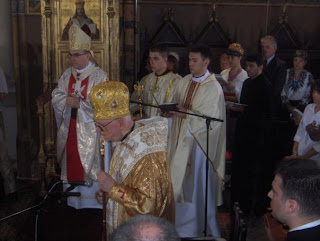
Presentation of the new Catechism of the Ukrainian Greek Catholic Church in Argentina

Last June this year, the Ukrainian Greek Catholic Church after ten years of preparation, and after the review of the Congregation of the Eastern Catholic Church in the Vatican, have just published the first ever Catechism to guide the 10 Million Faithful of the Ukrainian Greek Catholic, headed by their Patriarch, His Beatitude Sviatoslav Shevchuk, and the released of this one is timely, due to his Election this last Macrh prior to the resignation of His Beatitude Cardinal Lubomyr Husar. And one of his top Priority is the Evangelization

Here below is the Excerpt of the Information regarding the New Catechism of the Ukrainian Greek Catholic Church, coming from the Website Religious Information Service of Ukraine

"In June of this year, after ten years of preparation, the Ukrainian Greek Catholic Church (UGCC) –the largest Eastern Catholic Church in union with the Pope of Rome– released its first official Catechism. EntitledChrist our Pascha, it received the unanimous support of all the Bishops of the Ukrainian Catholic Church and also was reviewed by the Eastern Congregation in Rome before publication. A description of the development process by the Patriarchal Catechetical Commission can be read here. Translation into other languages is proceeding, including Spanish, Russian, Portuguese and English.


There was speculation that the new Catechism might present some nuanced understandings of some of the issues that divide the Catholic and Orthodox Churches, especially with regards to the role of the papacy. However, some rough, unofficial translations of key paragraphs in the new UGCC Catechism indicate that this is not a breakthrough document that might suggest a way to resolve the doctrinal differences.

For example, here are two key paragraphs that describe the Pope:
291. Each local congregation in administering the Eucharist by its bishop and through community of faith comes into communion with the other local congregations. Local congregations being in communion form the Local Church headed by a primate – a bishop, archbishop, metropolitan or patriarch. The first among the local Churches is the Roman Church, since it has the Pope of Rome – a successor of Apostle Peter – as its primate. He is the teacher and the rule of the apostolic faith, to whom the Lord gives a gift of infallibility in the matters of faith and morals. Just as apostle Peter expressed a love to Christ that was greater than that of the others and received a commission from Christ to tend his flock (cf. Jn 21:15-18), so the Roman Peter’s Chair “presides in love”244 and holds primacy among the local churches245. This primacy is effected through Peter’s ministry of the Roman bishops, which our Church confesses in the title “The Most Holy Universal Hierarch”.
Footnote 245 is translated below:
[Footnote]245. VATICAN II, Dogmatic Constitution about the Church Lumen Gentium, 13, see also i.d. 18: “So that the episcopate itself would be kept in unity and indivisibility, He put Saint Peter over the other apostles and established in him a continuous and visible origin and foundation for the unity of faith and communion (cf. Vatican I, Dogmatic Constitution Pastor Aeternus, (18.07.1870): Denz. 1821 (3050 w.). And this teaching about establishment, continuity, power and sense of the sacred primacy of the Roman Hierarch and about his infallible teaching is again given by the Sacred Council to all believers for their steadfast believing.”
It is important to note again that the translations provided here are unofficial. I would welcome input from those who know Ukrainian who might offer improvements in the translation. It does seem clear, however, that by citing both Pastor Aeternus from Vatican I and Lumen Gentium from Vatican II the traditional doctrines of papal infallibility and primacy taught at those Councils are being reaffirmed in the new UGCC Catechism.
A couple of paragraphs later, the Council of Florence (one of the failed “union” councils between East and West) is directly quoted to explain the Pope’s universal care of “the whole Church.”

293. Christ entrusts the ministry of Church universality to the apostle Peter: “I have prayed for you that your faith may not fail. And when you have returned, strengthen your brothers.” (Lk. 22:32). The Bishop of Rome – a bearer of Peter’s ministry – convenes Ecumenical Councils, approves of their decisions, ascertains and expresses the infallible doctrines of the Church, resolves difficulties that arise in the life of local Churches. The ministry of the Roman Hierarch testifies of “the most ancient apostolic times”247. His ministry is to “strengthen the brothers” in common faith (cf. Lk. 22:31-42), be a “rock” (cf. Mt. 16:18) and a “shepherd” (cf. Jn. 21:15-18). “It is to him (the Roman Hierarch), in St. Peter, that Jesus Christ passed on the whole authority to tend, manage and take care of the whole Church, as it is established at the Ecumenical Councils and in the sacred canons”248.
247. See Dmytro Tuptalo, Lives of Saints. October 11. Remembering the 7th Ecumenical Council.
248. Council of Florence, Oros.
The union decree (available here under the date of July 6, 1439) of the Council of Florence, which was rejected by Orthodoxy as a whole, served as a basis for union of  the various Eastern Catholic Churches with Rome. The Florentine decree is cited a few more times in the new UGCC Catechism: in a discussion of the procession of the Holy Spirit (paragraph 98), when discussing Purgatory (paragraph 250), and in discussing East-West unity (paragraph 306).
The new UGCC Catechism also reaffirms the teaching of the Immaculate Conception of the Virgin Mary, quoting Pope Pius IX’s proclamation made in 1854:
311. The Church universally confesses that Mary, the Mother of our Lord Jesus Christ, is the Theotokos and Ever-Virgin, and venerates her in the festivals of the liturgical year. In the festivals dedicated to the Theotokos the Church prayerfully commemorates the salvific events from Theotokos’s life: Conception by St. Anna 274, Christmas, Introduction to the Temple, Annunciation, Presentation and Dormition, seeing in her an example for our growing in holiness

Footnote 274 is below:
274. The Pope of Rome Pius IX by his bull Ineffabilis Deus(December 8, 1854) proclaimed the dogma on the Immaculate Conception of the Blessed Virgin Mary: “The Most Holy Virgin Mary from the moment of Her very conception by a special blessing and privilege from the Almighty God, in view of the merits of Jesus Christ, the Savior of the human race, was protected against any spot of the original guilt” (DS 2803; also CCC 491).
Icon of the Immaculate Conception

I asked about these issues in a letter to UGCC Bishop Peter Stasiuk(who was involved in the production of the new Catechism). In his reply, Bishop Peter explained that the new Catechism:
was not written as an ecumenical statement. You cannot speak of ecumenism if you do not know who you are. I suppose this is a starting point for our ecumenical dialogue with others. But at no time did we have ecumenism in mind. Our task was to explain our church as clearly as possible to our people.

 His Grace Most. Rev. Peter Stasiuk, C.SS.R, Eparch of the Ukrainian Greek Catholic Eparchy of Australia; Head of the Catechetical Commission of the Ukrainian Greek Catholic Church

The official English translation is due out in late 2012. I’m sure that further research on the new UGCC Catechism will reveal many areas of common identity between Eastern Catholics and Orthodox. A future article will go into the new Catechism in greater detail.
However, this initial look at the new Catechism indicates that it is solidly in the Catholic tradition and is not to be, as some had hoped, a document suggesting new approaches to issues that divide East and West.
________________________________________________________________

Now i hope that by this Catechism People will now that the Catholic Church is truly diverse in different Rites and Traditions.


Read more...

AKATHIST Hymn to the The holy, glorious and all-laudable Apostle and Evangelist Luke

Tuesday, October 18, 2011


Troparion (Tone 5) 
 Let us praise with sacred songs the Holy Apostle Luke,
The recorder of the Joyous Gospel of Christ,
And the scribe of the Acts of the Apostles,
For his writings are a testimony of the Church of Christ:
He is the Physician of human weaknesses and infirmities.
He heals the wounds of our souls, 
And constantly intercedes for our salvation!

Kontakion (Tone 4) 

You became a disciple of God the Word, 
With Paul you enlightened all the world,
Casting out its darkness by composing the Holy Gospel of Christ. 

Kontakion (Tone 2)
Let us praise the godly Luke:
He is the true preacher of piety,
The orator of ineffable mysteries
And the star of the Church,
For the Word who alone knows the hearts of men,
Chose him, with the wise Paul, to be a teacher of the gentiles!


Today we celebrate the Feast of the Apostle and Evangelist St. Luke, although a Physician, is a talented Artist and responsible to the very first Icon of the Most Holy Theotokos with our Lord as a Child. Besides that, he is known for writing the Synoptic Gospel and the Acts of the Apostle, which also makes him a Historian. 
In traditional depictions, such as paintings, evangelist portraits and church mosaics, 

St. Luke is often accompanied by an ox or bull, usually having wings. 
Also, only the symbol may be shown, especially when in a combination of those of all Four Evangelists.


Read more...
Another Major Archiepiscopate pleading to become a Patriarchate!!!

Monday, October 17, 2011

Besides the Ukrainian Greek Catholic who has been flooding the Vatican for almost 4 decades of Petition to have themselves elevated in the Patriarchate. I also did not put away this another pleading which has been created by another largest Sui Iuris Eastern Catholic Church, which is the Syro Malabar Catholic, elevated into a Major Archiepiscopate in 1992, has been making enormous attempts just like the Ukrainian Greek Catholics in Rome to be elevated into a Patruarchate. Here below is the Article from the Blogspot The Syro Malabar Church and the explanations of why there should be a need to be a Patriarchate.

Why we need a Patriarchate???

While reading this, one of the things that reminds me is how the Vatican makes a conflict regarding the Self Government of the Sui Iuris Self Governing Eastern Catholic Churches. Yes they are very supportive to the Liturgical Tradition, Theological Patrimony and the different Popular forms of Piety. But the main thing is the Self Autonomy which is in question in here??!!! Well the situations of the Major Archiepiscopal Churches like the Eastern Catholic Patriarchates are indeed Self Governing in many aspects, though not all, cause they are all under the Communion and the Juridical Authority, if ever he asserts this if he Presides in Charity, of the Holy Father the Pope, the Holy Ecumenical Pontiff of Rome.


St. Thomas Cross, the Symbolic Emblem of the Syro Malabar Catholic Church.


Read more...

A Byzantine Catholic Hierarch's letter pleading to the Pope against "Latin Rite Superiority Complex"!! :)))

Sunday, October 16, 2011


His Grace Most. Rev. Isidore Borecky (1911-2003) is the first Apostolic Exarch of the Ukrainian Greek Catholic Exarchate (Later Eparchy) of Toronto and Eastern Canada. Being aware of repression done to the Byzantine Catholics in Canada and United States as well, in 1989 he write a letter to the then Pope His Holiness Blessed John Paul II pleading to him not to prohibit any Married Priest to exercise their Ministry in Canada. Below is the statement he has written to the Pope (All Citations mine")

"Over the last century, the attempt to impose celibacy has not succeeded, but it has provoked at least three schisms in North America, as follows:

1. The schism led by Archpriest Alexis Toth commencing in Minneapolis in 1891. The vast majority of members of the Russian Orthodox Churches in the U.S. and Canada are descended from former Catholics who left the Church through this movement;


 Alexis Toth, the Ruthenian Byzantine Catholic Priest who led the mass conversion to Orthodoxy in the 19th century

2. The schism which formed the Ukrainian Greek-Orthodox Church of Canada during and after the First World War. Except for new immigrants, virtually all the members of this denomination are former Catholics and their descendants;

 Archbishop John (Theodorovych) the first Metropolitan of the Ukrainian Orthodox Church of Canada

3. The celibacy schism of the 1930's in the U.S. led by Father (later Metropolitan) Orestes Chornock, which resulted in the formation of the American Carpatho-Russian Orthodox Greek Catholic Diocese and its reception into the Orthodox Patriarchate of Constantinople.

 Orestes Chornock, first Metropolitan of the American Carpatho-Russian Orthodox Diocese of the United States

These schisms were attended by acrimonious court battles, disgraceful public spectacles which resulted in many enduring wounds to the body of Christ, the Church, and serious scandals to the detriment of the Catholic cause. They are still a major obstacle to ecumenical relations....

Hierarchs of Ukraine have been ordaining married priests and sending them to us for a century, from Metropolitan Sylvester Cardinal Sembratovynch, through Metropolitan Andrew Sheptytsky, Joseph Cardinal Slipyj (who in Rome itself ordained at least 46 such priests for the diaspora without any objection from the Holy See) and now the present Eastern Catholic hierarchs in Ukraine.


His Excellency Metropolitan Cardinal Sylvester Sembratovych, Ukrainian Greek Catholic Metropolitan Archbishop of Lviv and Primate of all Rus (1882-1898)

 His Grace Metropolitan Andrey Sheptytsky, Ukrainian Greek Catholic Metropolitan of Lviv and Primate of all Rus (1900-1944)

At the very least, Your Holiness, surely it is not improper to ask for an explanation of this complete innovation. Since Pope Pius Xll established the Eparch of Toronto we have received married priests who were ordained in Ukraine or elsewhere in Europe on the instruction of Cardinal Tisserant, and until today there has been no objection.

Cardinal Eugene Tisserant, Secretary of the Congregation of the Eastern Catholic Churches

 
 His Holiness Pope Pius XII

 How, When, and Why has this policy changed?
Any attempt to prevent the priests ordained in Ukraine from exercising the sacred ministry would provoke an immediate and vehement protest from the faithful, and even from the reverend clergy. These priests have been received with very great joy, and they are carrying out much needed pastoral work. Suddenly interrupting that work now would do irreparable harm to the peace of the Church here."


 _____________________________________


Do i have to put more Lines there, hope not and Vladyka Isidore is quite right after all


The same Operative of the Dominant Latin Rite which has force itself upon Byzantine Catholics in the late 19th century is still alive in the 20th and even at the early wee's of 21th century.


Though we pray that all maybe One, i am not skeptic that Unity will be at hand soon!!!


Vechnayat Pamyat Vladyka Isidore at this endeavor of yours to plead to the Vatican!!!!! +


His Grace Most. Rev. Isidore Borecky on his early years as Bishop.


Read more...

EPISCOPAL ORDINATION OF NIKOLA NINO KEKIC, CROATIAN BYZANTINE CATHOLIC CHURCH

Thursday, October 13, 2011


"On Saturday, July 4.2009, Nikola Nino Kekić, the newly appointed bishop of the Greek Catholic Eparchy of Križevci, was ordained in the Greek Catholic cathedral of the Holy Trinity in Križevci. The consecrator was Msgr. Slavomir Miklovš, the apostolic administrator of the Eparchy of Križevci. The co-consecrators were the archbishop and metropolitan of Zagreb, Cardinal Josip Bozanić, and the apostolic nuncio in the Republic of Croatia, Archbishop Mario Roberto Cassari, who read the bull of appointment at the beginning of the ceremony."


An excerpt of Information regarding the Cheirotonia, or Laying of Hand, of His Grace Most. Rev. Nikola Kekic and below is a Cited excerpt from the Principal Co Consecrator Cardinal Josip Bozanic, Latin Rite Roman Catholic Archbishop of Zagreb:


"Addressing Bishop Kekić, Cardinal Bozanić noted that the motto he has chosen, "God is Love," expresses the Christian image of God in a concise and very clear manner. Since God first loved us, Christian love is not a commandment but rather a response to the gift of love. The cardinal urged Bishop Kekić as a good shepherd to assemble his scattered and small flock of Greek Catholic Croats, Rusyns and Ukrainians in Croatia, Bosnia and Herzegovina and Slovenia, to strengthen them in Catholic faith and encourage them, although they are small in number, to be proud of their Church heritage.

Cardinal Bozanić urged the new bishop of Križevci to safeguard and build the community of presbyters, religious and Christ's lay faithful throughout the entire eparchy, Bishop Kekić thanked everyone who has accompanied him thus far on his path of life. He thanked Pope Benedict XVI who appointed him as the thirteenth bishop of Križevci, and the twenty-ninth in the series of bishops of Marča-Križevci, as well as the co-consecrators. On his own behalf as well as on behalf of the priests and faithful of the Eparchy of Križevci, he particularly thanked Msgr. Slavomir Miklovš, who had led the diocese for 26 years, including the war years. Bishop Kekić greeted the assembled clergy with special joy. He urged the faithful to pray fervently for the clergy that they may rise above mediocrity, to be holy bishops and holy priests. He suggested that Croatian families should spend more time together. Let us find time for each other, despite the devastating tempo of life that tramples every person and his dignity, said the bishop."


And some of the Taken Pictures in the Episcopal Ordination see here below:


Read more...

In honour of the First "Patriarch" of the Ukrainian Greek Catholic, His Beatitude Cardinal Josyf Slipyj (1892-1984)

Wednesday, September 28, 2011


Because i can't upload this Videos via Youtube, i have to post them as Links about the Blessing of the Monument in honour of the first "Patriarch", which is of course being given in honour by the Holy Synod of the Ukrainian Greek Catholic to their Major Archbishop without the proper Recognition from the Vatican, though they consent in giving such Title. It is also worth writing here the sacrifice the Ukrainian Greek Catholics have give to recognized this "Patriarchate" since the time of His Beatitude Cardinal Josyf Slipyj until this present Major Archbishop His Beatitude Sviatoslav Shevchuk. For more than 4 decades, they sought such Approval from the Pope's Apartment, though it ended up in vain and of course, "Ecumenical" tactics.

The Ceremony of the Blessing was presided by His Grace Innocent Lotocky, OSBM, Eparch Emeritus of the Ukrainian Greek Catholic Eparchy of Chicago, and one of the Oldest Hierarchs not just of the Ukrainian Greek Catholic Church but of the whole Catholic Church as well.

And here is the Link of this Article i made Many months ago in respect and honor of the first Major Archbishop, or should i say Patriarch, of the Ukrainian Greek Catholic Church, His Beatitude Cardinal Josyf Slipyj, and with proud he is also the "Last Man" standing in the Soviet Gulag, the only Hierarch to came alive.


Read more...

Pontifical Divine Liturgy in Commemoration of the 60th Martyrdom Anniversary of Blessed Martyrt and Bishop Theodore Romzha


The Video Footage is courtesy of  the  Orientale Lumen website, known for Videos of Liturgies in the Eastern Rite, both Catholic and Orthodox. This Pontifical Divine Liturgy was celebrated at the Ruthenian Byzantine Catholic Cathedral of Mukachevo in Uzhorod, Ukraine, Celebrated by the late Metropolitan Archbishop Basil Myron Schott, OFM, of the Ruthenian Byzantine Catholic Metropolia of Pittsburgh, concelebrated by all Byzantine Catholic Hierarchs, including the Bishop of Mukachevo, His Grace Milan Sasik, C.M

For Videos of Eastern Rite Liturgies, just click in this here and another one here for Liturgies in Arabic and Liturgies in English as well and below are some Photos taken in this Solemn Commemoration of the Anniversary of Blessed Theodore Romzha, who is also the former Eparch of the Ruthenian Byzantine Catholic Eparchy of Mukacheve until his Assasination in 1947.


Read more...